


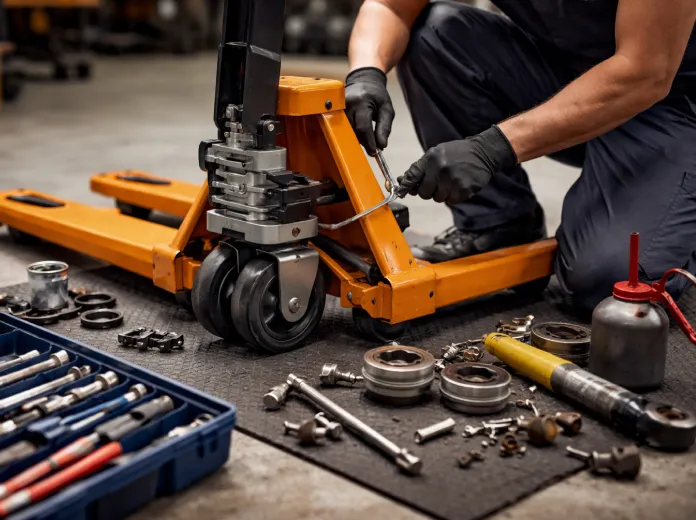
The Ultimate Hand Pallet Truck Maintenance Guide
If your warehouse floor feels like a workout zone lately, your equipment is likely screaming for help. A stiff handle or a jerky lift isn’t just an annoyance; it’s a sign that a breakdown is looming. Keeping your gear in top shape shouldn’t be a chore. With a bit of proactive hand pallet truck maintenance, you can keep your operations moving without the expensive “emergency repair” price tag.
At Tekin Plast, we build tools like the TP-25 and TP-30 to handle the heavy lifting, but even the toughest machines need a little love. Here is how to keep yours running like new.
Table of Contents:
How do I check the hydraulic oil in my pallet truck?
The short answer? Check it every six months. The hydraulic system is the heart of your truck. If the oil level drops or becomes contaminated, your forks won’t lift to their full height.
To check the level, lower the forks completely and place the truck on its side. Use a screwdriver to remove the filler plug on the pump reservoir. The oil should be about 1-2 cm below the edge of the opening. If it’s low, top it up with a high-quality hydraulic fluid.
3 Essential Steps for Daily Upkeep
You don’t need a toolkit for these. Just a pair of eyes and sixty seconds before your shift starts.
➤ Debris Removal:String, plastic wrap, and warehouse dust love to wrap around wheel axles. This creates friction that eats through your bearings. Clear it out daily.
➤ Leak Spotting:
Look for oil patches on the floor. Even a tiny “sweat” around the pump seals can lead to a total loss of lifting power by next week.
➤ Handle Check:
Ensure the control lever clicks into all three positions—Lift, Neutral, and Lower—without sticking.
Why Is Lubrication the Secret to Equipment Longevity?
Metal-on-metal friction is the silent killer of warehouse productivity. Your hand pallet truck maintenance routine must include monthly greasing of the pivot points and axles.
We recommend using long-life grease on the grease fittings (zerks) located near the wheels and the handle base. This prevents the “squeak and drag” that makes a 2,500 kg load feel like 5,000 kg.
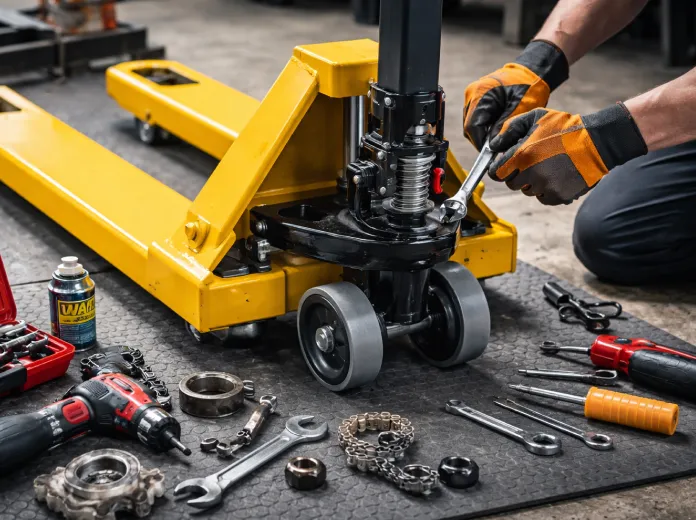
The Step-By-Step Monthly Deep Clean
➤ Pressure Wash (Carefully):
Clean the frame to spot hairline cracks in the steel early. Avoid spraying high-pressure water directly into the bearings or seals, as this can wash away the internal grease.
➤ Tighten the Fasteners:
Vibrations from uneven floors can loosen nuts and bolts. Grab a wrench and give the handle bolts and wheel axles a quick turn to ensure everything is snug.
➤ Bleed the Air:
If the forks feel “spongy” or don’t lift, you likely have air in the system. To fix this, pull the control lever to the ‘Lower’ position and pump the handle rapidly 10–15 times to push air bubbles back into the reservoir.
Final Thoughts on Hand Pallet Truck Maintenance
A well-maintained truck is a safe truck. Skipping a five-minute check today could lead to a dropped load or a strained back tomorrow. Is your team following a checklist, or are they waiting for something to break?
FAQ
It’s usually one of two things: low hydraulic oil or air trapped in the pump. Try the "bleeding" trick mentioned above. If that doesn't work, check your oil level. If the oil looks dark or milky, it’s time for a full oil change.
Please don't. Using engine oil or thick gear oil will ruin the seals and make the pump nearly impossible to use. Stick to ISO VG32 hydraulic oil. It’s designed to handle the pressure without gumming up the valves.
It depends on your floor. On smooth concrete, they can last years. If you're running over metal shavings or dock plates, you might see "flat spots" within months. Replace them as soon as you see cracks or if the truck starts vibrating excessively.
Probably not! Usually, the lowering valve just needs a tiny adjustment. There is a small nut on the chain assembly near the handle base. Loosening or tightening it by just a half-turn often solves the problem instantly.


