


How to Pick a Plastic Crate Supplier That Won’t Let You Down
You place a bulk order. The crates arrive two weeks late, the stacking feet crack after a month of normal use, and now your warehouse floor is a safety problem. This is not a hypothetical. It happens to procurement teams that pick a plastic crate supplier on price alone without checking anything else first.
There are a handful of things worth confirming before you commit to a supplier for ongoing needs. This piece walks through each of them clearly.
Table of Contents:
So What Actually Separates a Solid Plastic Crate Supplier from a Risky One?
Three things come up consistently: certifications, product depth, and the kind of support you get after the sale. Each one tells you something different about whether a supplier is worth a long-term relationship.
Start With Certification, Not the Catalogue
An ISO-certified supplier has had their quality management processes verified by an external body. That is not a marketing badge. It means their production follows a documented standard that gets audited regularly. When you are ordering closed crates, ventilated crates, or nested crates in volume, batch-to-batch consistency matters. Certification is the closest thing to a written commitment on
A Narrow Product Range Creates Problems Later
If a supplier only stocks one or two crate formats, you will outgrow them quickly. Operations change. What starts as a simple storage requirement often expands into temperature-sensitive goods, food transport, bakery distribution, or pharmaceutical handling. Each scenario calls for a different crate type.
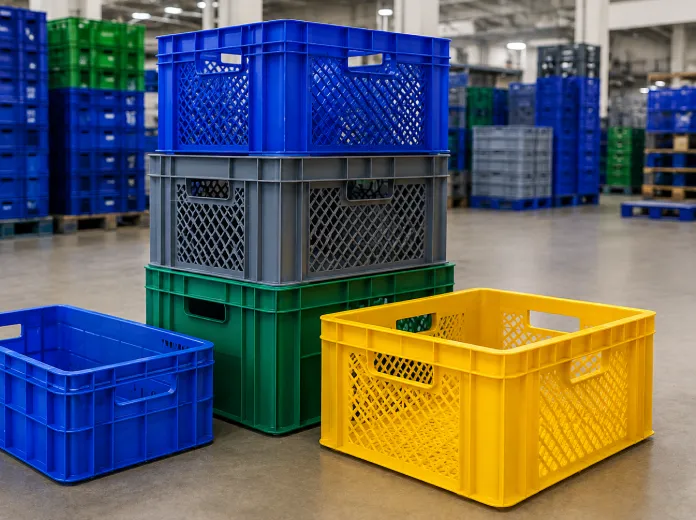
Look for a supplier who carries closed crates for protected storage, ventilated designs for produce and baked goods, nested crates for space-efficient return logistics, and specialist variants like fish crates or ingredient bins. A broad catalogue signals actual manufacturing depth rather than reselling someone else’s stock.
HDPE Is the Material Worth Asking About
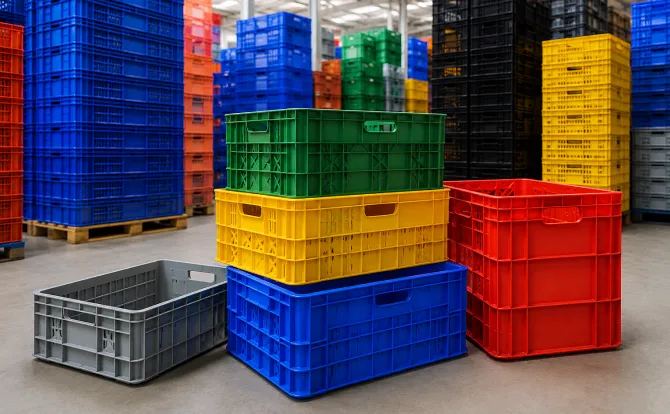
Not all plastic is the same. High-density polyethylene is the material standard for serious industrial crate applications. It handles chemical exposure, stays stable under heavy and repeated loads, and does not absorb moisture. Ask specifically whether the crates are UV-stabilised if they will see outdoor or high-exposure use. Cheaper polypropylene alternatives degrade faster, and when you factor in replacement cycles, they end up costing more per year than a better product purchased upfront.
Food and Pharma Applications Need More Than Just Plastic
If your supply chain moves food, beverage, pharmaceutical, or cosmetic goods, the material compliance question goes further than durability. You need FDA-compatible materials, smooth internal surfaces that clean without residue retention, and designs that do not harbour moisture in corners or joins. Ventilated crates help here because airflow reduces the conditions that encourage bacterial growth during transit or storage.
Stackability Is a Warehouse Safety Issue, Not Just a Space Issue
A crate that stacks properly has reinforced rims and standardised feet designed to distribute load vertically. A crate that does not stack properly creates unstable columns that shift, lean, or collapse under normal racking conditions. That is a safety incident waiting to happen, not just an inconvenience.
Nested crates are worth considering specifically for return logistics. When empty, they fit inside each other, which cuts the storage and transport footprint for empties by a significant margin.
Delivery Reliability Across the UAE Is Worth Confirming Early
A supplier based in Dubai or Abu Dhabi with genuine distribution coverage across all seven emirates is a different proposition to one that technically covers the UAE but treats anything outside the core city as a logistics exception. Before placing a first order, confirm lead times to your specific location, not just to Dubai. Ask what happens when a batch is short or damaged. The answer tells you more than the sales pitch does.
Tekin Plast operates from the Al Qusais Industrial Area in Dubai and covers delivery across the UAE, including Abu Dhabi, Sharjah, and Ajman. They carry closed crates, ventilated crates, nested crates, fish crates, and ingredient bins, alongside pallets and material handling equipment, with ISO certification backing their quality process.
The Support Question Most Buyers Skip
A supplier who asks about your load requirements, stacking height, goods type, and handling environment before recommending a product is one that understands the job. A supplier who just processes the order without asking anything is one that will be difficult to deal with when something goes wrong.
This is worth testing in the initial enquiry. Describe your use case and see whether the response is a SKU number or a conversation. The difference usually predicts the whole relationship.
Final Thoughts
Choosing a plastic crate supplier for ongoing needs is not a one-time transaction decision. The wrong call creates operational drag through delays, inconsistent product quality, and support that disappears when you need it. Running any shortlisted supplier through the filters above-certifications, material standards, product range, delivery reliability, and post-sale support, will save a lot of trouble later.
Which of these has caused the most friction in your past supplier relationships?
FAQ
Certification is the most objective starting point. ISO-certified suppliers operate under verified quality systems, which matters when you are ordering in volume and need consistency across batches. After that, check whether they actually carry the crate types your operations need, not just one or two generic formats.
A well-made HDPE crate handles hundreds of load cycles under normal conditions without structural failure. The actual lifespan depends on load weight, handling method, and whether the crates are being used within their rated capacity. They significantly outlast cardboard and most wood alternatives in comparable use.
Closed crates with reinforced bases and consistent rim dimensions are the most reliable choice for racking systems. They stack predictably, do not flex under vertical load, and interface cleanly with standard racking profiles. Always match the crate's stated load rating to the actual weight you plan to store per level.


